South Sumatra
South Sumatra Province is situated on the eastern side of Bukit Barisan mountain range South Sumatra provin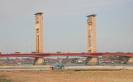 ce is relatively flat, nevertheless fertile, as numerous rivers crisscross and meander through out the region. Palembang is its capital city and as the gateway to the province, lies right on the banks of the great Musi River, 60 km upstream and navigable by oceangoing vessels. No wonder that most major social and economic activities should center in Palembang and Musi River where the region's pride, Ampera Bridge, is found as well. ce is relatively flat, nevertheless fertile, as numerous rivers crisscross and meander through out the region. Palembang is its capital city and as the gateway to the province, lies right on the banks of the great Musi River, 60 km upstream and navigable by oceangoing vessels. No wonder that most major social and economic activities should center in Palembang and Musi River where the region's pride, Ampera Bridge, is found as well. Because of its sheer location on the southernmost rim of the South China Sea and close to one of world's busiest sea-lanes linking the Far East with Europe, the region's historical background is undoubtedly rich and colorful. Once the very site of the Buddhist Kingdom of Sriwijaya, it practiced a bustling trade with then ancient China during its era dynasties. Inevitable of cours e, were the interacting forces of the two different cultures at the time, which nowadays are still noticeable as consequences of the past. e, were the interacting forces of the two different cultures at the time, which nowadays are still noticeable as consequences of the past. The visitors can easily reach South Sumatra by air through four major airports at Palembang, Pangkal Pinang, Bangka and Belitung islands, all having direct connections with Medan, Batam, Padang, Jakarta, and not long from now with Singapore too. Air-conditioned buses from points North and West of Palembang are regularly available, as well as from cities on Java and Bali. Geographically
Geogr aphically, South Sumatra province is located between 1o and 4o South Latitude and between 102o and 108o East Longitude. The boundaries of the area is: aphically, South Sumatra province is located between 1o and 4o South Latitude and between 102o and 108o East Longitude. The boundaries of the area is:
North side: South China Sea
West side: Jambi Province and Bengkulu Province
South side: Lampung Province
East side: Java Sea Administratively
South Sumatra Province is divided among 8 regencies, 2 municipals and 3 administrative towns with Palempang as its capital city. Temperature
The humidity of south Sumatra province is 78%. The rainfall range is variation between 2,000 - 3,000 mm per year and an average wind velocity of 3.23 km per hour. And the temperature ranges between 21.8o C and 32.2o C. Demography 
A migration flow to this province is supported by the existence of heavy plantation exertion, mining and transmigration program. The population density of this province is 58,8 people per Km2 (1994). Compared to the average national population growth amounted to 2.144% per year, this province was on the lower level with 1.10% per year.
|
|
Information and pictures courtesy of Indonesia Tourism. |
|