West Java
Of the 17,000 islands that make up the archipelago of the Republic of Indonesia, Java has historically been considered the heartland. Where Java has led-culturally, economically and politically down through the centuries, other regions have followed. On Java,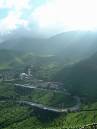 still the most densely populated island of Indonesia, there are five Provinces. West Java is the largest, with the greatest population, and, some would claim, with the most pride. still the most densely populated island of Indonesia, there are five Provinces. West Java is the largest, with the greatest population, and, some would claim, with the most pride. West Java Province is located at part of western Java Island. The enchanting of Sunda land stretches from Sunda Strait in the west to the borders of Central Java in the east. The locals' people know West Java Province as the Land of Sunda. The region is primarily mountainous, with rich green valleys hugging lofty volcanic peaks, many of which surround the capital of West Java province. The history of West Java is a story of trade, spices, and the rise and fall of powerful kingdoms. In the late 1500's the region was ruled from mighty Cirebon, which still survives as a sultanate today, although a shadow of its former glory. West Java was of the first contact points in Indonesia for Indian traders and their cultural influences, and it was here that the Dutch and British first set foot in the archipelago. This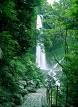 province has its own unique culture and language, both called Sundanese that is also used to call its people. The ancient kingdoms of Tarumanegara, Pajajaran, Banten and Cirebon would make interesting studies for the student of archaeology. Cirebon is located on the border between West and Central Java, having a mixed culture originating from the ancient Cirebon and Banten kingdoms, resulting in similar customs and dialects of the two people, although Banten is located at the extreme western part of the province. province has its own unique culture and language, both called Sundanese that is also used to call its people. The ancient kingdoms of Tarumanegara, Pajajaran, Banten and Cirebon would make interesting studies for the student of archaeology. Cirebon is located on the border between West and Central Java, having a mixed culture originating from the ancient Cirebon and Banten kingdoms, resulting in similar customs and dialects of the two people, although Banten is located at the extreme western part of the province. West Java province its self, is formed based on the Constitution number 11/1950 on the establishment of West Java. With the issuance of Constitution number 23/2000 on Banten Province, West Java Governor Assisting Territory I Banten was inaugurated as Banten Province with its territories comprising Serang Regency, Pandeglang Regency, Lebak Regency, Tangerang Regency and Mayoralty, and Cilegon Mayoralty. After the change, at present West Java consists of 18 regencies, nine mayoralties, 584 districts, 5,201 villages and 609 sub districts.
The capital city of West Java province is Bandung city. Bandung is situated 180 km southeast of Jakarta. The city gamed fame in 1955 as the venue for the first Afro-Asian Conference, w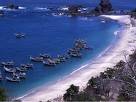 hich brought together the leaders of 29 Asian, and African nations with the aim to promote economic and cultural relations and take a common stand against colonialism. hich brought together the leaders of 29 Asian, and African nations with the aim to promote economic and cultural relations and take a common stand against colonialism. The road from Jakarta to Bandung passes through a beautiful panorama of mountains, paddy fields and small holiday resorts. An expressway connects the crowded capital city with Bogor and the mountain areas, and onward to Bandung. It has a number of sea resorts on its western and southern coasts, which have modern hotels and are popular during the weekends. The Sundanese people are soft-spoken. The women of the Bandung region are known for their beauty. A lighthearted people who have a love for bright colors, their mournful "kecapi" music is memory of beautiful legends.
|
|
Information and pictures courtesy of Indonesia Tourism. |
|